Humoresque has decided to tackle the subject of music practice.
Yes, I know. Again!
It has long been a mantra of music teachers everywhere that it’s better to practise “little and often”, rather than one enormous splurge on the morning of your music lesson.
In principle – I can see why people say this.
In practice – it depends.
Let me take you back to when I was a fourteen year old schoolboy. I’d asked for a trumpet for my birthday. I got a trumpet for my birthday. As soon as I opened the box, I realised my mistake. What I’d really wanted was one of those cool instruments with a slide which sounded like a hippopotamus calling to its mate.
Ah yes. Of course. I should have asked for a trombone.
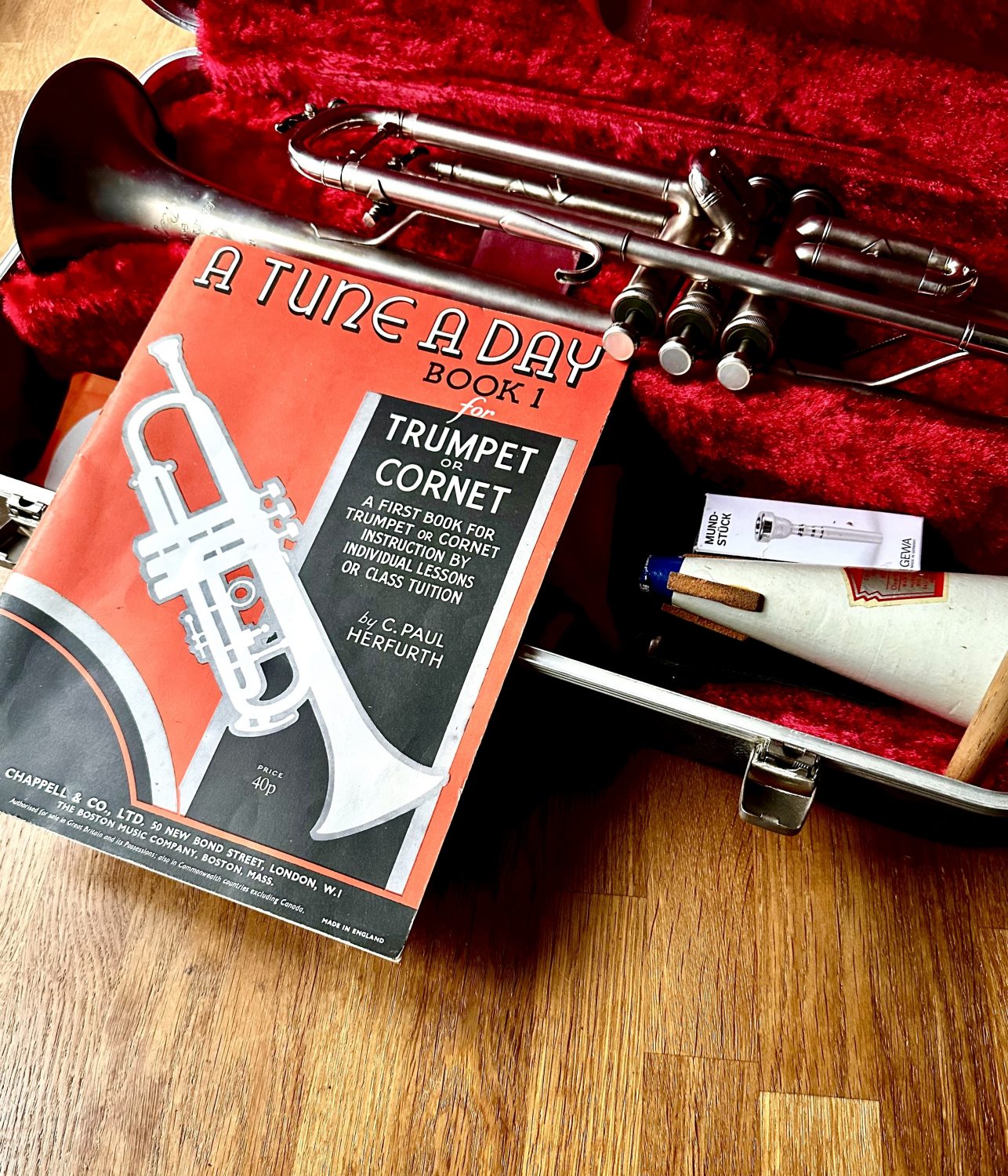
No matter. I had a trumpet in my hands now, so next thing was – find out how to play it. This I did by trial and error, but my parents had also provided me with a book: “A Tune A Day for Trumpet or Cornet”. This helped a lot. Pretty soon, I could play many tunes-a-day, and I thought I was very good. Don’t forget, I’d been having piano lessons since I was three, and I played the cello too. This trumpet was an add-on to all that. I thought I could master it without too much trouble.
My parents weren’t so sure. They booked lessons for me, so along I went every Saturday morning to a wonderful ex-military bandsman called Frank Wilson. There were three of us in a group lesson, and Frank had us marching around his living room playing bugle calls. He set us homework – you know, stuff to practise. I didn’t have a notebook, but he would mark the date next to a song in my Tune A Day book, and I was supposed to go off and spend time each day on that.
But I didn’t. I had other things to do. I won’t list them in detail, but I’m sure you can imagine a fourteen-year-old’s priorities: football, bike rides with mates, girlfriends, homework (sometimes), school (unfortunately) etc, etc. Although we weren’t burdened with social media then…
Anyway, back to the trumpet. My lessons with Frank Wilson were on Saturday mornings at 9am, and my mum would drive me to Frank’s house, leaving ours at about 8.45. If you’d been in, or possibly outside, my house on a Saturday morning at 8am, you’d have heard me going through the piece with today’s date next to it. And yes, I do mean “going through”. I didn’t practise it. As in, there was no metronome, no idea of breaking it down or of checking my tone, my breathing, my technique and other important elements. I’d play my trumpet for around twenty minutes, then I’d put it in its box ready for its weekly trip to Frank’s.
And now you must imagine me standing in Frank’s living room with the other two boys looking on. They’ve done their solo performances, and they’ve had good, useful feedback from Frank.
“Ok, Rory,” Frank says. “Your turn now. Let’s hear your piece.”
I play my piece. I think it’s the bee’s knees.
“Not bad,” Frank says. “Not bad at all.” It’s his policy to be eternally encouraging. “But you need a rounder tone. Did you do those exercises we tried last week?”
“No, sir,” I say truthfully. (We all call him “sir”. He’s been in the army, after all.) “I’m sorry. I forgot to do the exercises.”
“Well, never mind,” he says. “We can do them again today.”
So we do them again today, and I immediately hear a difference in my playing.
And then Frank tells us three kids to line up behind him, and the four of us parade around his living room playing our favourite bugle calls and marching tunes. It’s brilliant!
The next week, the same thing happens, but minus the exercises. That’s because, having revised them once, I now know what to do, and I don’t need to practise them again.
My trumpet playing improves every single week. I love the lessons. I love marching in a circle playing my trumpet. I love Frank Wilson, a tall man with a soft voice and a wonderful way with children.
Could I have made better progress if I’d practised “little and often”? I don’t think so. I think it would have stifled my enjoyment, because that came mostly from engaging with Frank and the other boys, and with making music together.
But you can bet I practised the piano every single day, which must count as “often”, but it wasn’t “little”. I practised the piano a lot.
I had a dragon of a piano teacher who thought I would go on to do great things and was determined to be instrumental in that. She was married to a lunatic choirmaster who was eventually arrested for interfering with little choirboys. She left him before that, though, and was found wandering around Piccadilly Circus in the middle of the night, dressed in her nightie and clutching her toothbrush.
Yeah, really. No wonder I practised the piano!
My cello teacher was an endearing old lady called Julia Pringle. She lived in Sheen Lane near Richmond Park, and she had a couple of yappy dachshunds who stood at the top of the stairs and drowned out my playing with their noise. Mrs Pringle herself was lovely, and we would sit opposite each other in her living room, each with a cello between our knees. In the last ten minutes of the lesson, my mum would be called through from the freezing cold hallway, where she’d spent the last three-quarters of an hour shivering, to accompany us on the piano. This was the best time of all, because Mrs Pringle and I would play our cellos, while Mum would play the piano, and even the dachshunds stopped their yapping to listen to our music. It was heavenly.
I practised my cello “little” but not “often”, although it became more frequent as I got further up my grades. I think the cello was my favourite instrument at the time, especially as I could play it in my school orchestra. I started learning it when I was eight, but as the years went by, it became less and less fun. I did the minimum amount of practice to fool Mrs Pringle, who, by the time I was a teenager, was really rather doddery. She still thought of me as the little eight-year-old boy who could play anything by ear, and she didn’t demand enough of me. I didn’t realise that then, but I can see it now.
None of my instruments received the “little and often” treatment. None of them needed it. I went on to get Grade 8 in all three of my instruments (piano, cello and trumpet), and later added recorder to the list. I was lucky to have good, inspiring teachers, although they were all very different, and I was even luckier to have aptitude, and a mother who was an expert piano player and musician. Oh, and luckier still to have been given the opportunities to learn and the instruments to learn on.
My point is, you have to judge for yourself. What works? What doesn’t? Do you have confidence in your teacher? (If not, find someone else.) If you do, are they happy with what you do each week? Are you happy? But even if you think I didn’t practise my instruments as much or as often as I should have done, you’ll appreciate that I didn’t give up on anything. I went through to Grade 8 with all my instruments.
And so should you.
I tried to find a photo of fourteen-year-old me playing the trumpet, but there doesn’t seem to be one. I do still have my trumpet, though. It’s very precious to me. And I even have my original Tune A Day book!